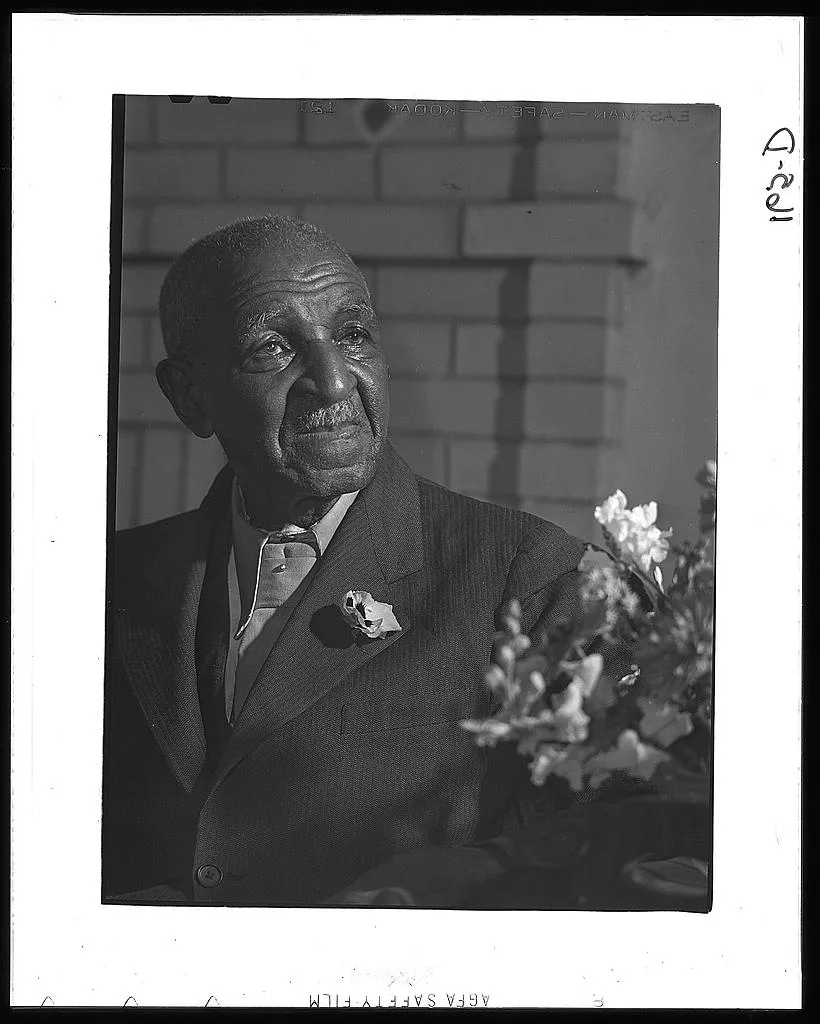
Dr. George Washington Carver, Tuskegee Institute, Alabama (1942)
An elderly George Washington Carver, in a tweed suit with a flower in his lapel, sits before a brick wall beside a spray of blossoms. Arthur Rothstein photographed the scientist at Tuskegee Institute in Alabama for the federal government's photography project; the Library of Congress dates the portrait to March 1942, less than a year before Carver's death. It has become one of the most widely reproduced late portraits of Carver.
- Photographer
- Arthur Rothstein (1915–1985), for the Farm Security Administration / Office of War Information
- Date
- March 1942 in the Library of Congress caption; some later portfolio prints are dated 1941
- Place
- Tuskegee Institute (now Tuskegee University), Tuskegee, Alabama
- Sitter
- George Washington Carver (about 1864–1943), agricultural scientist and educator
- Original caption
- Tuskegee Institute, Alabama. Dr. George Washington Carver
- Negative
- Safety film negative, 3 1/4 x 4 1/4 inches or smaller (Library of Congress FSA/OWI collection)
- Also known as
- George Washington Carver, Tuskegee, Alabama; Rothstein's portrait of George Washington Carver
How the portrait was made
By the early 1940s Arthur Rothstein had been photographing for Roy Stryker's government unit for several years; it began in 1935 under the Resettlement Administration and is best known by the name of the Farm Security Administration, and its pictures now form the FSA/OWI collection at the Library of Congress. On a trip through Alabama, Rothstein photographed at Tuskegee Institute, where George Washington Carver had taught and done research since 1896.
The Library of Congress catalog entry, reproduced in the agency's America from the Great Depression to World War II collection, titles the photograph Tuskegee Institute, Alabama. Dr. George Washington Carver, and dates it March 1942. The negative is listed as a safety film negative of 3 1/4 x 4 1/4 inches or smaller. Rothstein made other pictures on the campus during the same visit, including one of uniformed Reserve Officers Training Corps cadets, which is also in this archive.
Who it shows
George Washington Carver was born into slavery in Diamond Grove, Missouri, around 1864; the exact date is not known. He studied at Simpson College in Iowa and then at Iowa State, where he earned his bachelor's and master's degrees, finishing the master's in 1896. That year Booker T. Washington invited him to lead the agriculture department at Tuskegee.
At Tuskegee, Carver urged Southern farmers to rotate cotton with soil-restoring crops such as peanuts, sweet potatoes, soybeans and cowpeas, and he published dozens of practical bulletins for farmers, the most popular of them on the peanut. He took his teaching on the road in a mobile classroom known as the Jesup wagon. In 1921 he testified before the House Ways and Means Committee in support of a tariff on imported peanuts, and by the 1930s and 1940s he was a national celebrity; Time magazine called him a Black Leonardo in 1941. He died at Tuskegee on January 5, 1943, and was buried on the campus beside Booker T. Washington. Rothstein's portrait therefore shows Carver in the last year of his life.
Why it became well known
Because the portrait was made by a federal photographer, it entered the public domain and has been reprinted freely ever since. The Encyclopedia of Alabama's image of Carver is a Rothstein photograph credited to the Library of Congress, and a cropped version of Rothstein's March 1942 Tuskegee portrait, drawn from the Library of Congress, is used in Wikipedia's article on Carver and in several other language editions. For many readers it is the face of Carver in old age.
Rothstein also chose the image for his own later portfolios. The Amon Carter Museum of American Art holds a signed gelatin silver print made in 1981 for a portfolio published by Hyperion Press, number 3 in an edition of 50, and included it in the museum's 2022 exhibition Black Every Day, a survey of photographs of Black American life. The Spencer Museum of Art at the University of Kansas owns another print from an Arthur Rothstein portfolio.
What to look for
The portrait is quiet and formal. Carver sits turned slightly to the left, looking past the camera rather than into it, with soft window light falling across his face and white moustache. The texture of the brick wall behind him and the coarse weave of his suit give the picture a tactile quality, while the pale blossoms in the lower right corner echo the flower pinned to his lapel. Rothstein's framing makes the flowers part of the portrait's subject: a plant scientist shown among plants.
On this archive's scan you can also see the edges of the original negative, including handwritten and printed markings along the border, which are working marks from the film and filing process, not part of the composition.
Dates and the version in this archive
The sources give two dates. The Library of Congress caption dates the portrait to March 1942, and the Wikimedia Commons copy follows that date. Museum records for Rothstein's later portfolio prints, at the Amon Carter Museum and the Spencer Museum of Art, date the image to 1941. No source we read explains the difference, so this page follows the Library of Congress date for the negative and notes the portfolio date as an alternative.
This archive's image comes from the Library of Congress FSA/OWI record titled Tuskegee Institute, Alabama. Dr. George Washington Carver, catalogued as a safety film negative of 3 1/4 x 4 1/4 inches or smaller. It is the seated, bust-length portrait in front of a brick wall with flowers at the lower right, the composition described in the museum records. It is a scan of the full negative, so it includes the film border that is cropped away in most published versions.
Frequently asked questions
Who took the famous photograph of George Washington Carver with a flower?
Arthur Rothstein, a photographer for the federal Farm Security Administration and Office of War Information, made this portrait at Tuskegee Institute in Alabama. The Library of Congress dates it to March 1942. Carver was photographed by many people over his long career, so other well-known Carver portraits are by different photographers.
When was Rothstein's portrait of Carver taken?
The Library of Congress caption gives March 1942. Some museum records for prints Rothstein made later for portfolios give 1941. Carver died on January 5, 1943, so either way the picture shows him near the end of his life.
Is the George Washington Carver portrait by Arthur Rothstein public domain?
Yes. It was made by a federal government photographer, and the FSA/OWI photographs at the Library of Congress are in the public domain. That is why it appears so widely in books, encyclopedias and on Wikipedia.
Where did George Washington Carver work?
At Tuskegee Institute (now Tuskegee University) in Alabama. Booker T. Washington invited him in 1896 to head the school's agriculture department, and he remained at Tuskegee for the rest of his life, dying there on January 5, 1943.
Sources
- George Washington Carver (Wikipedia)
- File:George Washington Carver-crop.jpg (Wikimedia Commons)
- George Washington Carver, Tuskegee, Alabama, collection record (Amon Carter Museum of American Art)
- George Washington Carver, Tuskegee, Alabama, collection record (Spencer Museum of Art)
- George Washington Carver (Encyclopedia of Alabama)
- George Washington Carver, Legendary Figures: Library of Congress caption (AIT web archive)