Farmer and Sons Walking in the Face of a Dust Storm (1936)
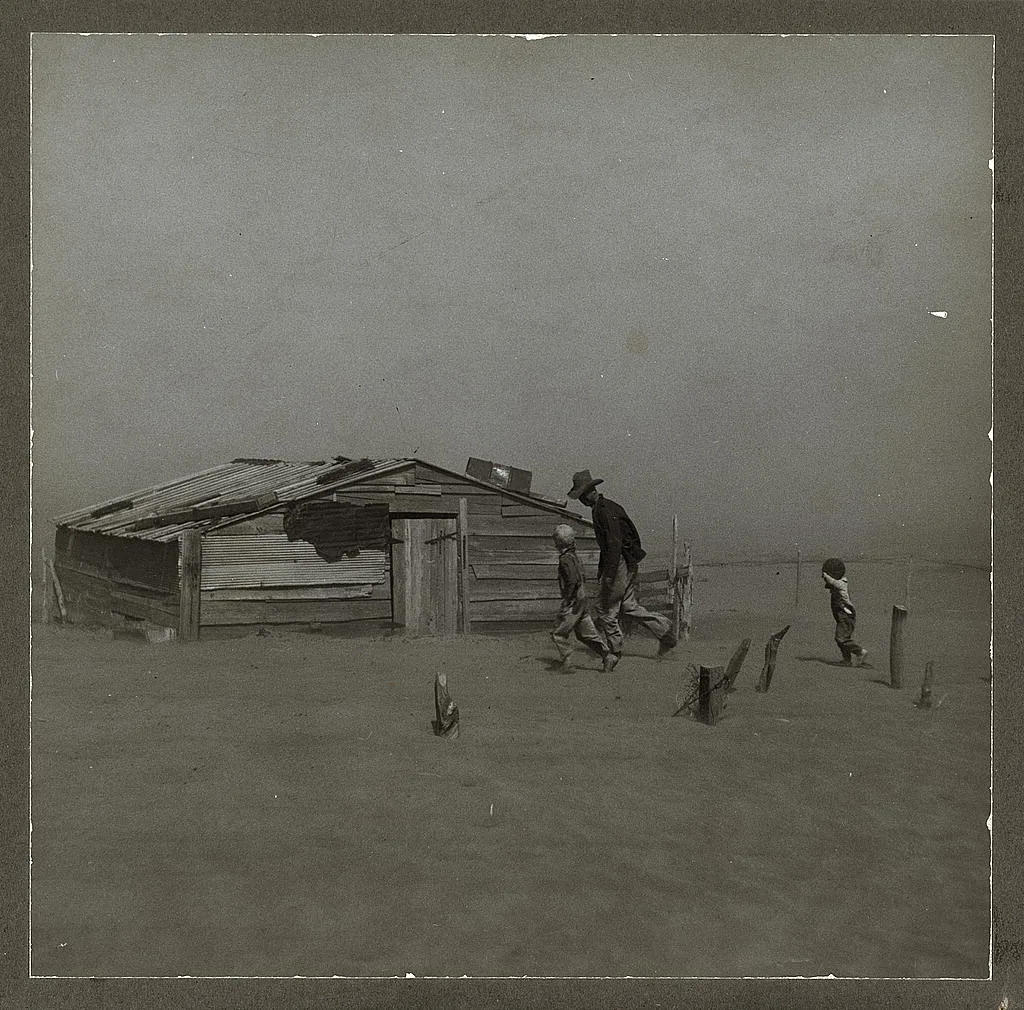
A farmer and his two young sons walk past a weathered shed while dust buries the fence posts around them. Arthur Rothstein made the photograph in Cimarron County, in the Oklahoma Panhandle, in April 1936, and it became one of the defining images of the Dust Bowl. The family was later identified as Arthur Coble and his sons Milton and Darrel. Whether the scene was directed has been debated for decades.
- Photographer
- Arthur Rothstein (1915–1985), for the Resettlement Administration (later the Farm Security Administration)
- Date
- April 1936
- Place
- Cimarron County, Oklahoma Panhandle, on a rented farm near Felt
- People shown
- Arthur Coble (1896–1956) with his sons Milton Garth Coble (1930–1973) and Darrel Arthur Coble (1933–1979)
- Original caption
- Farmer and sons walking in the face of a dust storm. Cimarron County, Oklahoma
- Collection
- Library of Congress, FSA/OWI collection (public domain); later prints in museums including the Amon Carter Museum and Middlebury College Museum of Art
- Also known as
- Fleeing a Dust Storm; Dust Storm, Cimarron County, Oklahoma; Arthur Coble and sons in a dust storm
How the photograph was made
In the spring of 1936 Arthur Rothstein was a young staff photographer for the federal Resettlement Administration, the agency whose photography unit, run by Roy Stryker, would become famous under the name of its successor, the Farm Security Administration. Rothstein had met Stryker, then an economics instructor, at Columbia University, and Stryker hired him in 1935 as the unit's first staff photographer. Rothstein's assignment that spring took him to the southern Plains, where years of drought and wind erosion had stripped the topsoil from farms across the region.
In Cimarron County, the westernmost county of the Oklahoma Panhandle, he photographed a farm family on rented land near the town of Felt. Rothstein's caption, written for the agency's files, named no one: it read simply that a farmer and his sons were walking in the face of a dust storm in Cimarron County in April 1936. The negatives went back to Washington to join the growing government file of pictures of rural America.
Who and what it shows
The farmer was later identified as Arthur Coble, born in 1896 in Sailor Springs, Illinois, whose family had moved to Oklahoma soon after statehood. The taller boy striding beside him is his older son, Milton Garth Coble, and the small child trailing behind with his hand raised to his face is the younger son, Darrel Arthur Coble. According to a 2013 profile of the family in 405 Magazine, six people lived in a three-room house on the rented farm, and drifting sand sometimes blocked the shed door so completely that calves had to be lifted through a hatch in the roof.
The picture is built from very few elements: a low, sagging shed, a line of fence posts nearly swallowed by drifted soil, three figures, and a sky so thick with dust that the horizon disappears. Rothstein later said the photograph showed an individual in relation to his environment, and the composition makes that point plainly. The people are small, the land and air are enormous, and the only shelter in sight is a ramshackle outbuilding.
Was it staged?
The photograph has carried a staging debate for decades, and the sources do not agree. A Middlebury College Museum of Art essay on its print of the image, drawing on Rothstein's 1979 book Words and Pictures and on historian James Curtis's 1989 study Mind's Eye, Mind's Truth, says the picture was a reenactment: Rothstein described asking the father and older son to lean forward as if walking into a strong wind and asking the small boy to cover his eyes. The Encyclopedia of the Great Plains adds that other frames from the same day show clear skies and little visible dust.
Other accounts disagree. The 405 Magazine profile reports that the Coble family and Rothstein both described the moment as candid, and that his contact sheets show a run of frames of the family at work, including the father and older son digging fence posts while the youngest played in the sand. A Great Bend Tribune article says Rothstein spent most of an afternoon with the family and made the famous exposure as he was packing up to leave. What no one disputes is that the Cobles were a real family on a real dust-ravaged farm, and that Rothstein chose his moment and framing with care.
The question mattered in 1936 because Rothstein was already at the center of another controversy. During the 1936 presidential campaign a North Dakota newspaper, the Fargo Forum, criticized his repeated use of a cow skull to dramatize drought on the Plains, and the story was turned against the Roosevelt administration. Many papers later retracted it after Stryker defended the skull's artistic use, but the episode left critics alert to any sign of staging in government photographs.
Why it became famous
According to 405 Magazine, the photograph ran in newspapers across the country soon after it was made, and over the following decades it became one of the images most often used to stand for the Dust Bowl and the Depression on the land. The Encyclopedia of the Great Plains calls it Rothstein's most famous image, and Middlebury describes it as one of the best-known photographs of the era.
Rothstein returned to the image in later decades. The Amon Carter Museum of American Art owns a signed print made in 1976 for a limited-edition portfolio, and the 405 Magazine profile reports that a signed print sold at Christie's in New York in December 2011 for $21,250. The family's own story has become part of the picture's meaning: the profile notes that both boys died in their forties, and that Darrel's gravestone carries an inset image of the little boy chasing his family through the dust.
What to look for
Look first at the fence posts. Their tops barely clear the drifted soil, which tells you how much ground has moved. Then follow the figures from left to right: the father and older son walk in step with heads down, while the smaller boy lags behind, half turned, with his arm up against the wind. That gap between the adults' purposeful stride and the child's struggle gives the picture its tension.
The square format and the low, flat light are also worth noticing. There are almost no shadows, because the dust diffuses the sun, so the scene reads as a pale, grainy field in which the dark shapes of the shed and the people stand out sharply.
The version in this archive
This archive's image comes from the Library of Congress FSA/OWI record titled Farmer and sons walking in the face of a dust storm, Cimarron County, Oklahoma, dated 1936. The catalog lists a negative and an 8 x 10 inch photographic print, and the scan shows a print with its border visible. It is the well-known frame with the father, the older son and the small boy trailing at the right. No other frames from the session are held here. Other prints of the same image, printed later by Rothstein, are held in museum collections, sometimes under the shorter title Dust Storm, Cimarron County, Oklahoma.
Frequently asked questions
Who is in the Fleeing a Dust Storm photograph?
The farmer is Arthur Coble (1896–1956), and the boys are his sons Milton Garth Coble, the older boy walking beside him, and Darrel Arthur Coble, the small child trailing behind. Rothstein's original caption did not name them; the family was identified later.
Where and when was the photo taken?
In April 1936 in Cimarron County, in the far western Oklahoma Panhandle, on a rented farm near Felt. Rothstein was working for the federal Resettlement Administration, whose photography unit became part of the Farm Security Administration.
Was Fleeing a Dust Storm staged?
Accounts conflict. A Middlebury College essay, citing Rothstein's own later writing and historian James Curtis, says he directed the father and sons to lean into the wind and the youngest to cover his eyes. Other accounts report that the family and Rothstein described it as a candid moment. All agree the family and the dust-covered farm were real.
Is the photograph in the public domain?
Yes. It was made by a federal government photographer for the FSA, and the Library of Congress lists the FSA/OWI photographs as free of known copyright restrictions. Signed prints Rothstein made later are objects in museum and private collections, but the image itself is public domain.
Sources
- Arthur Rothstein, Dust Storm, Cimarron County, Oklahoma (Holden Luntz Gallery)
- Arthur Rothstein, Dust Storm, Cimarron County, Oklahoma, April 1936 (Middlebury College, Land and Lens)
- Oklahoma's True Grit Dust Bowl Family, 77 Years Later (405 Magazine)
- Image conscious (Great Bend Tribune)
- Rothstein, Arthur (Encyclopedia of the Great Plains)
- Farmer and Sons Walking in the Face of a Dust Storm, collection record (Amon Carter Museum of American Art)